Artificial intelligence has long ceased to be a buzzword and has become a practical tool. In 2026, teams that don't use AI for task management lose 3 to 5 hours per week on routine work: manual processing of incoming tasks, prioritization, decomposition of large tasks. In this article, we'll explore which AI capabilities actually save time — and how they're implemented in TaskFly.
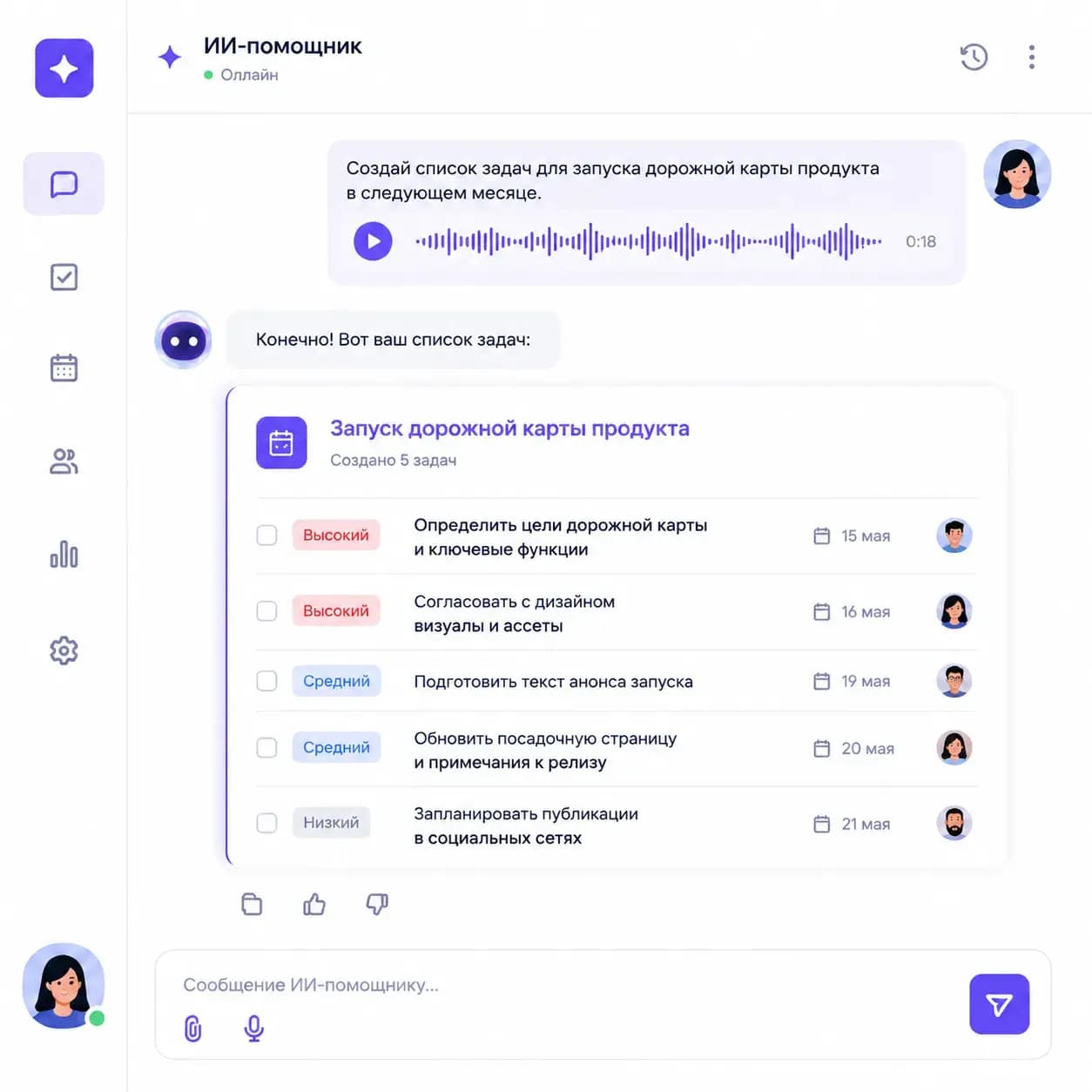
Voice Task Input: Dictate Instead of Typing
Imagine: you're driving to a meeting and remember you need to assign a task to the designer. Instead of stopping to type, you send a voice message to the TaskFly Telegram bot: 'Ask Anton to prepare landing page mockups by Friday, high priority.' AI recognizes speech with over 95% accuracy, extracts the task name, assignee, deadline, and priority — and creates the task automatically.
The technology is based on the OpenAI Whisper model, adapted for the Russian language. Unlike standard dictation, TaskFly doesn't just transcribe text — it understands context: identifies the task essence, determines priority from intonation and keywords, finds dates and names.
Task Extraction from Documents and Photos
Another powerful scenario is document upload. Did a client send a 10-page technical specification? Upload the PDF or Word file to TaskFly, and AI will break it down into specific tasks. Each task gets a name, description, estimated priority, and tags. All you need to do is review the list and assign team members.
Tip: photograph the whiteboard after a brainstorming session — TaskFly will recognize the text and create tasks from each item on the board.
The same mechanism works with photos. Photographed the board after a planning meeting? Uploaded a screenshot of a client conversation? AI recognizes text (OCR), identifies tasks, and creates them in your project. For teams that frequently work with incoming requests, this is a huge time saver.
AI Prioritization: Smart Priority Assignment

One of the most underrated AI features in task management is automatic priority assignment. When a project has 50+ tasks, determining what to do first is a non-trivial task in itself. TaskFly analyzes deadlines, task dependencies, team member workload, and completion history — and suggests the optimal order.
According to our data, teams using AI prioritization close 23% more tasks on time compared to manual management.
Automatic Decomposition: From Big Goals to Concrete Steps
Got a task like 'Launch new landing page'? It's too large to execute. TaskFly's AI can break it down into subtasks: prepare a brief for the designer, write copy, build the page, set up analytics, run an A/B test. Each subtask gets a realistic deadline based on your team's average completion speed for similar tasks.
- Voice input — create tasks on the go via Telegram bot
- Documents and photos — upload files, AI creates tasks
- Auto-prioritization — AI sets priorities based on deadlines and workload
- Decomposition — large tasks are automatically broken down into subtasks
- Data anonymization — your data is protected during AI processing
Data Security in AI Processing
One of the main concerns with using AI is data security. TaskFly automatically anonymizes tasks before sending them to the AI model: names are replaced with placeholders, confidential data is masked. Servers are located in Russia, ensuring compliance with Federal Law 152-FZ.
Conclusion: AI Is Not a Replacement for Managers, It's Their Amplifier
AI in TaskFly doesn't make decisions for you — it removes routine and gives you more time for strategic tasks. Voice input saves minutes on each task, automatic decomposition saves hours on sprint planning, and smart prioritization helps you never miss a deadline. Try it free and see the difference.